A week ago I sent over my first draft of the piece, which has the working title ‘Sileán na Carraig’. Based on our group discussion, I wanted to include a theme that was of the style of a traditional slow air. I did a reasonable amount of the composition at the piano, so that I knew it was playable, but also so that I could hear how the harmonies sound – particularly as they increase in distance from the theme’s tonal centre – in relation to the lower part.
Once I have heard a few questions on the music I will be quick to return with a more developed work.
Questions on the First Draft (Darragh 24/01/2020)
On receiving the first draft of the composition, I was intrigued to get started and to find out more about Padruig’s composition methods and his thought process behind the piece. This is an important process as I always endeavour to find out the composer’s intentions before playing a piece.
(1.) The title-Sileán na Carraig: Since this is a traditional based piece, it seems obvious that the title be in Irish! I’m wondering what would the English translation of this be? Something similar to “The Weeping Rock”?
(2.) As we discussed in our first meeting, the basis of this composition draft is a slow air. The elements of slow air combined with contemporary classical music is very evident such as the absence of a strict metre, repeated notes, ornamentation and more. Is this based on any particular slow air? And when you composed this, did you experiment first through playing?
Regarding Technical Demands from a Performer’s Perspective (Darragh 24/01/2020):
(1) As I’m playing the primo part, I will have to ripple some of the chords as some chords are too large to play at once. Some of the large chords I can manage, however some such as the the chord in bar 26 (left hand), I will have to ripple this;
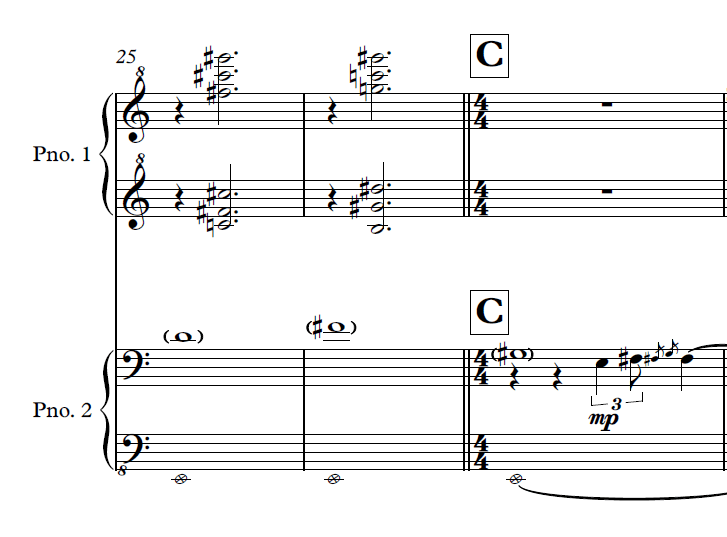
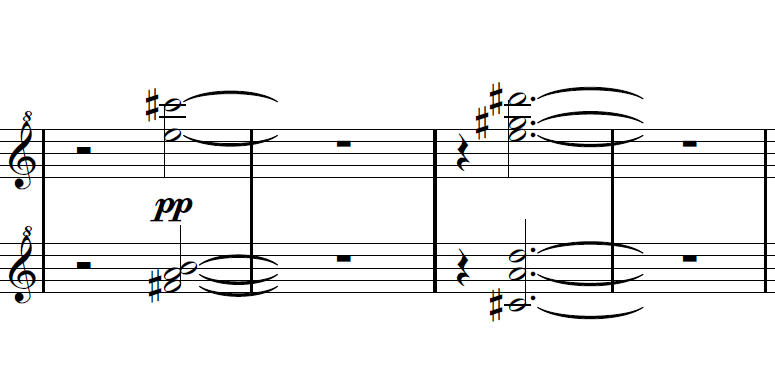
(2.) My last question pertains to bar 20 and 22: I presume the ties mean that the chords are held into the next bar for an indefinite amount of time through the sustain pedal? Here is the relevant section;
Answers 25/01/20 (Pàdruig)
Thank you for your questions!
- Yes the title is along the lines of ‘The Weeping Rock’, or ‘The Rock’s Tears’, as I felt I wanted to pick a subject matter for the title, that felt at home with a context of traditional music. However, the rock also brings to mind matters of size, scale and vastness, an aspect which I hope to consider through the use of harmony. A rock is full of different shapes, contours and colours, which also inspires a multi-modal harmonic approach to the melody, and to the more colourful harmonies.
- The theme (slow air melody) is my own composition. I wrote it with two modes in mind: E dorian, and E lydian. If you split the tune in two, the lower octave is in E dorian, and the upper in E lydian. By moving ever brighter and sharper as the melody goes on, a more colourful harmonic language is facilitated.
I have played it all the piano which was helpful in giving me a feel for how it should turn out. - You are correct to ripple any chords that are too wide. LH bar 26 is too wide for me too, but a swift ripple will work well.
- You are correct that the ties over the barlines to nothing indicate that the chords should resonate until the following bar. However, I think I will modify this – it’s not helpful, and leads to uncertainty about the crotchet rest immediately before the next chord.
Good luck!
Also a question from me – we talked initially about a slow air then becoming something quicker. I’m still worried that doing that would then prohibit the slow section from properly developing. Now that you’ve had a chance to see the material, and the climactic development of the slow air theme is yet to be reached, how do you feel about it’s pacing/development? Do you think we need a faster section too?
Response (Darragh 26/1/2020)
Thank you Pàdruig for answering those questions and for explaining your thought process behind the composition. Regarding your question, I understand your concerns. I think it would be best to develop the slow air, rather than composing a fast section and not give either section the time it deserves to develop. As you mentioned yourself, the climactic development has not yet come to fruition.
For the next while, I will be concentrating on formulating my thoughts on the piece and of course learning it too. I will document my thoughts and learning process in my next post. Once Semester 2 starts, Soledad and I can begin rehearsing, which I am looking forward to. My thesis is related to piano duets and I have not played a piano duet in quite a long time-so this collaboration will be beneficial to me.
Questions on the First Draft (Soledad 26/01/2020)
First, I would like to thank Pàdruig for the composition of this beginning of the work, I am looking forward to play it. Then, I would like to thank Darragh for referring to the title of the composition, since I do not know Irish, it is interesting to know an approximate translation when imagining the piece as a work of programmatic inspiration.
1. Within the interesting explanation you make about the use of the modality, I would like to know how you make the choice of chords, if you choose them purely because of their sonority or if there is an internal process.
2. I also agree on the question you ask about maintaining the slow tempo of the piece, the development must still be sustained to reach the climax, although I would like to suggest something, instead of changing to a faster tempo, could you develop more the piano primo figuration?
Regarding Technical Demands from a Performer’s Perspective (Soledad 26/01/2020):
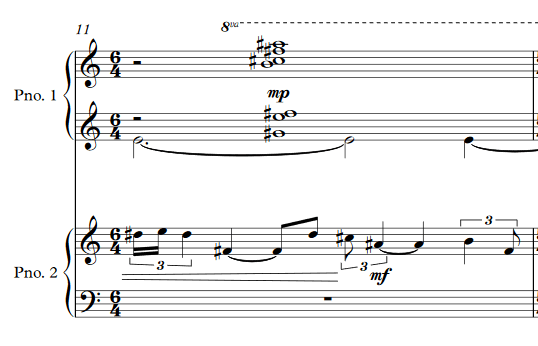
1. Should the mordents that appear in the theme be played quickly? (compared to the written figuration of measure 11 of the piano secondo)
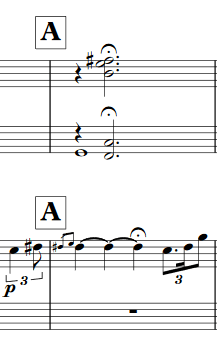
2. When the resonating harmonics appear, you clearly indicate the pitch you want to hear. I understand that it depends on where you stop the string, it will produce a harmonic or another.
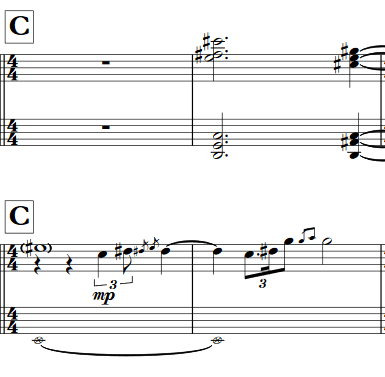
3- In section C, should the tonal pedal be used to maintain the bourdon and be able to play the theme clearly or do you want everything to be maintained with the same pedal?
Answers 30/01/2020 (Pàdruig)
Thank you for your thoughtful questions.
1. The process of coming up with the chords involves listening to their sonorities, but also a process of thinking about harmonic colour. The piece begins in the sound world of E dorian, and so initial chord fit with in that mode. As the melody gradually brighten, with the adding of sharps, towards the E lydian mode, so too do the chords brighten. I have then taken this further so that it doesn’t stop at D# or A# but continues pushing upwards and sharper. Hence the E#s (Fs), B#s (Cs), Fdouble#s (Gs) etc.
2. Thank you for the suggestion. I will develop the primo part next and add more movement.
3. Ornaments. The ornaments should be played as fast as possible, and on the beat (not slightly before). This is the traditional style of ornament/gracenote. The main weight is on the first gracenote, then the second gracenote and the main note fall afterwards.
The ornaments should be much fast than the semi-quavers in bar 11.
4. String harmonics. Yes – you are correct. Experiment with it. It will just be a case of moving your finger towards you along the string to get what I have written. Some chalk or postit note might be useful in performance for getting the right place quickly.
5. At C, perhaps the pedalling needs to follow the primo part’s chords, but with the secondo keys held down, it should still resonate. This is something that will be easier to discuss when we are all together at a piano.
Thank you for your questions so far. Which is your preferred sections so far? I will work on the parts now and develop the material of the primo part in particular.
Response (Soledad 01/02/2020)
Thank you very much Pàdruig for the clarity in your answers. Now I know how to play the ornaments that appear on the piano secondo. In relation to the string harmonics, I asked the question because it is curious that some contemporary compositions that I have played with this extended technique indicated the place in which to stop the string. It really seems more accurate to mr what you have done, since you indicate the sound result you want. In any case, the use of some chalk or postit will definitely be helpful.
C is so far my favorite section, I really like how all the materials you have used have converged; the chords of the piano primo, the string harmonics and the main theme.
Finally, the suggestion I made about adding more movement to the piano primo is also related to the title. Earlier you explained that the title is along the lines of ‘The Weeping Rock’, or ‘The Rock’s Tears’, you also added, ‘A rock is full of different shapes, contours and colors’, which is very good translated, from my point of view, to the musical aspect. Perhaps the ‘liquid’ part of the title (weeping, tears) could inspire other shapes and movements.
 MU625 Pàdruig - Soledad - Darragh