Pàdruig 23/02/20
Long overdue, though not without any correspondence, I met up with Darragh and Soledad individually to look over the score. These were very useful meetings, with several outcomes and points discussed below, which resulted in a number of (minor) modifications to the score (attached below).
Both performers are getting on very well with their parts. I think it would be helpful for them both to meet up as soon as possible so as to get to grips with the challenges that will occur when playing each part in conjunction with the other. This will be particularly apparent when it comes to peddling. I suspect that Darragh will pedal the beginning and the end, and that Soledad will pedal from letter D to bar 60. There is double peddling required in the very last section which I discuss below.
The biggest change that was required was in letter D, where there was frequent overlapping of parts. To avoid this, most occurrences of the ornamental figure in the Primo L.H. (e.g. bar 39) have been moved up an octave. The Secondo part has been moved down an octave in bar 57 to help with spacing as well.
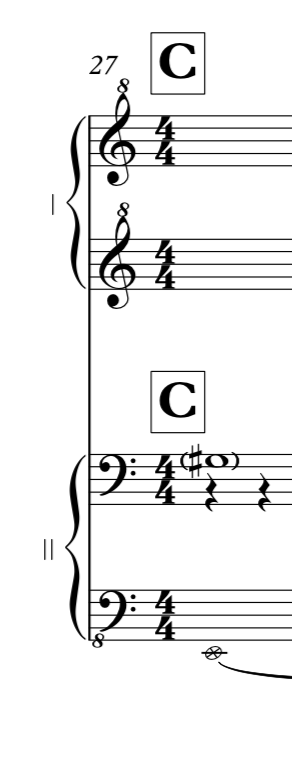
I stress again how important awareness of whether the clefs (as per the example below) are at pitch or if they are an octave up or down, so as to not completely misread certain sections.
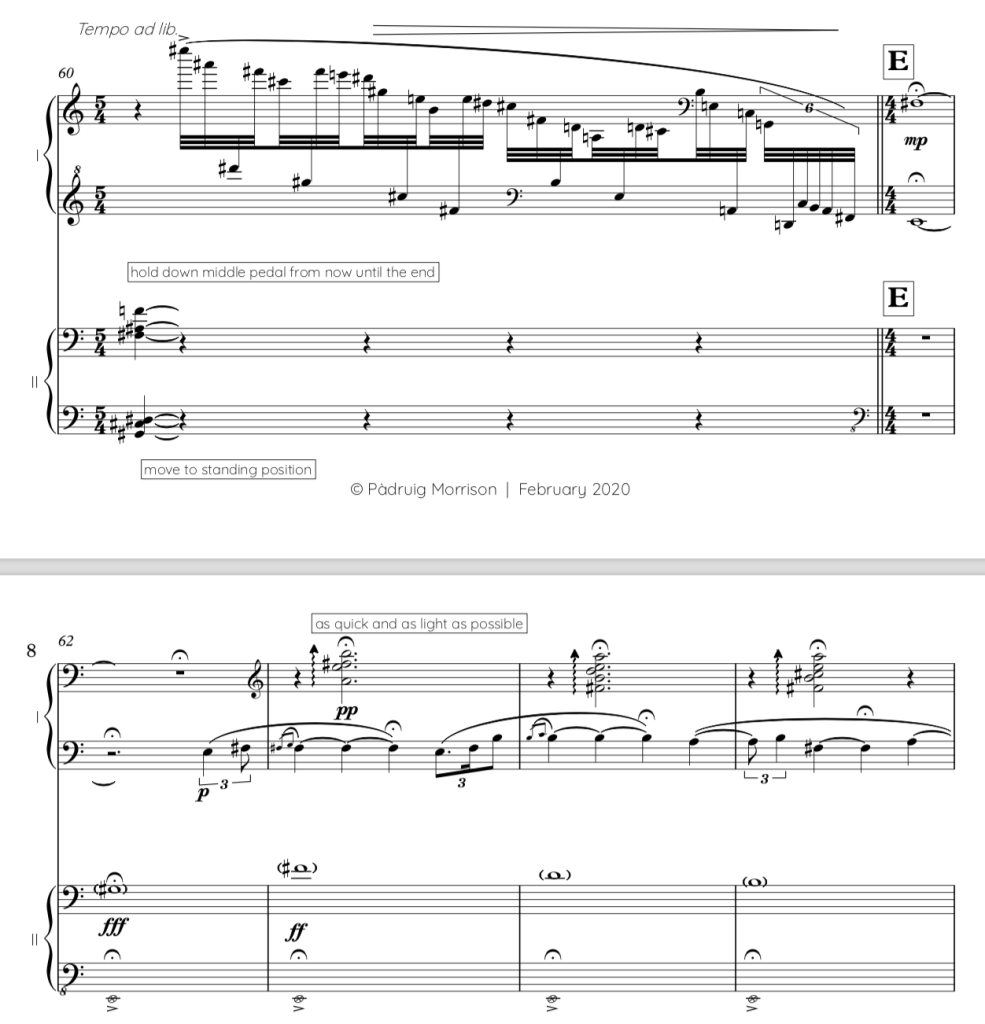
When playing through the music, I felt it needed a small amount of adjusting in bars 60 – 62. Rather than both parts playing the start of bars 60 and 61, there is now a rest at the start of bar 60 in the Primo part, so that the big descending run will start after the Secondo’s chord. Likewise, rather than playing together at bar 61, the Secondo part will do the E with the harmonic a bar later.
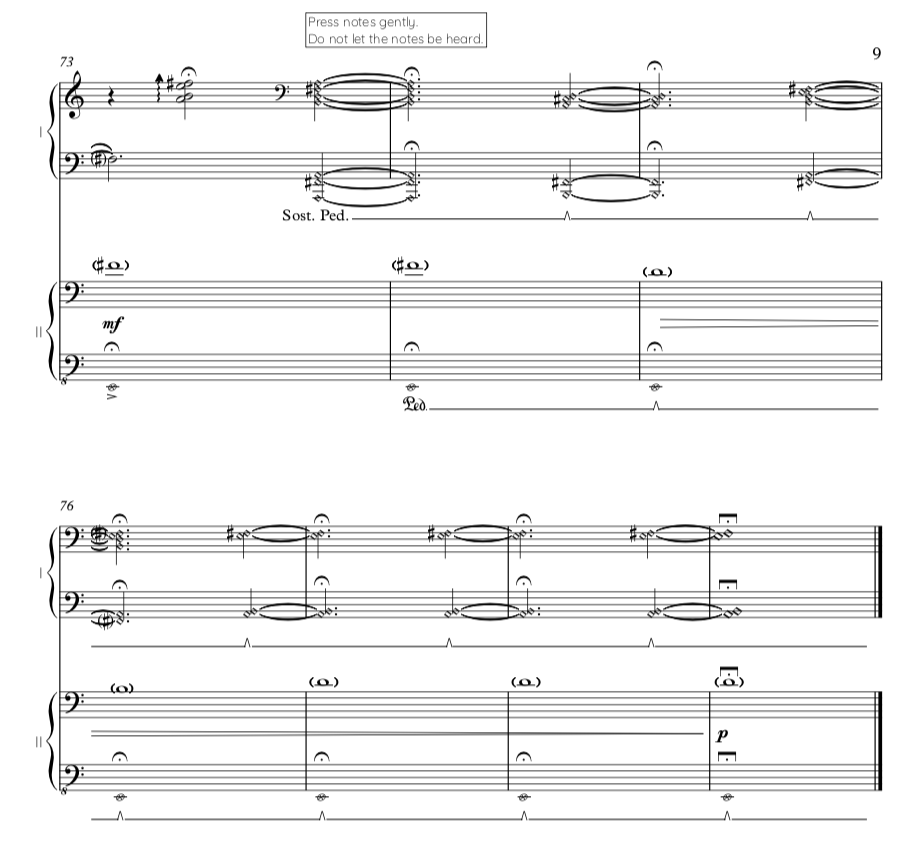
The next alteration that was necessary was from bar 73 to the end. The harmonics from the silently pressed keys are most effective if they are played two octaves lower, with the addition of the sostenuto pedal, and a subtle use of the sustain pedal to cover the change of chord in the Primo part. I have notated it as follows, even though the Primo pianist (Darragh) will probably pedal both.
I’m looking forward to hearing the piece with both players. The piece can be done a bit slower that 70bpm is required, and please do practice section D very slowly to begin with.
Below I have a PDF, and a link to download Sib 8, Sib 7 first, or MP3 files should they aid the learning process.
Meeting with Pàdruig and First Rehearsal with Soledad (Darragh 27/02/2020 )
Both Soledad and I met with Pàdruig individually to play through the piece and to see how things work together. There were a few parts where the primo and secondo clashed so Pàdruig promptly fixed this and sent us a revised version. Now the ornamental figures of my primo part are an octave higher, bringing me to the extreme of the piano. Some of Soledad’s parts have been lowered an octave. There are a few spots where our hands slightly overlap but this is manageable. An example of this is the start, where the melody and the chords are in and around the same place.
Pedalling is crucial in this piece. I am pedalling the beginning and the end. Soledad is pedalling section D to bar 60. At the end, the sostenuto pedal must be used as well as the sustain, in order to manage the harmonics. Prior to the first rehearsal with Soledad, I had listened to the Sibelius track of this piece a few times to get more of an idea of the nuts and bolts, however this being a new piece means that it is our responsibility to bring the piece to life. We rehearsed it one section at a time, mostly working on synchronicity. We will rehearse again before the workshop on Wednesday and hopefully the piece will be taking shape by then.
 MU625 Pàdruig - Soledad - Darragh