Overview of Workshop on 05/03/2020 (Darragh)
Yesterday morning, a useful workshop for the composers and performers was held by Prof. Palmer and Dr. Molloy. Soledad and I performed first. Following this, we were given feedback and were asked to perform parts of the piece again, masterclass style. The other performers played too, and some of their feedback was also applicable to our duet performance.
It was very useful performing on this piano as it will be the piano used in the lunchtime recital-particularly for Soledad, as she has harmonics to execute and each piano has a different feel and sound. The piece has got better in terms of synchronicity and now it is time to progress the piece further. We hadn’t given the pauses enough consideration, particularly in the beginning-this was an aspect commented on during the feedback. Padruig’s score is very clear here-so I need to pay attention to this detail. This freedom in the beginning sets the tone for the piece, it’s very calm and still (the end as well). The D section contrasts with the first section as the piece gains momentum and provides a big contrast to the opening section, with the fff chords and the extremities of the piano being used. There is a lot more room for both parts to explore the dynamics and sound world, and my ornaments need to be more articulated. In terms of logistics, Ryan suggested Soledad and I swap just one note, in order to avoid our hands overlapping. This was bar 50.
Also, in the more busy section, section D, I believe we started off with a good sense of pulse but that dwindled slightly by the end of D. I suggest that Soledad and I work on this, perhaps with a metronome first. Dr O’ Leary gave very helpful advice regarding duets. We need to be one player, not two. This means we need to communicate more in order to be singing from the same hymn sheet so to speak-whether it be through eye contact, a gesture etc. He suggested we decide what to do with the rests beforehand, deciding on a certain amount of beats, or elongating the pause each time we do it etc. Overall, the workshop gave us a very good idea of what to work on next in order to strengthen the concept of the piece. No doubt we will try to incorporate these new elements in our next rehearsal.
The lunchtime concert is approaching and another aspect that we need to consider concerns the running of the recital itself-the logistics of performing. Introductions (who is the speaker?), acknowledgment of the composer (will we acknowledge the composer by bringing him up on stage at the end?) and timings. Another aspect worth considering in advance is where will Soledad and I sit, and our walk-ons to the stage. Soledad is due to perform as a soloist first, then the duet, then me as a soloist-this means there will be a fair amount of moving around. Finally, the programme notes for the recital must be written. This will include a brief biography on three of us and a short description of the pieces. Programme notes are particularly important for new works. For staple works in the repertory, programme notes do not hold the same practical significance, as the listeners may already have heard the piece before at a previous concert for example. The aim of programme notes is of paramount importance in contemporary classical music in shaping the both the listeners’ and performers’ perceptions and concept of a work. The intriguing relationship between composers, performers, listeners and the score is portrayed below;
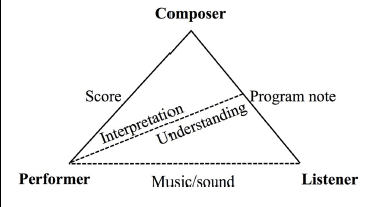
As musicians, we spend so much time honing our craft and practising minute details, and sometimes we do not take these logistics and overall presentation into account until the last minute. Sometimes it is hard to do that as we may not be familiar with the set-up, venues and so on. However, in this case (thankfully), we are privy to the set-up of the Riverstown Hall lunchtime recitals. If we are fully prepared for the co-ordination of the performance,it will allow us to concentrate on the most important element-the performance itself!
Video Recordings of Practice (Darragh)
Here are two recordings of my practicing two sections of the piece. I find recording myself a very useful tool in improving. It’s particularly helpful in our case as this is the piano and the recording equipment I will be using for the (Conica microphone)final recording.
 MU625 Pàdruig - Soledad - Darragh