For ease of access, I’m leaving the full score here.
Quarantine time
Soledad (17/04/2020)
Due to the new and unexpected situation, the study of the piece and its final performance have varied greatly.
After the cancellation of the lunchtime concerts, new Guidelines for Performance Examinations: Remote Mode have been created specifying that the exams will be replaced by video recordings, which Darragh and I will record individually.
However, the decisions that we are going to apply to our performance are not individual but are negotiated in advance to show consistency on key interpretative elements (like tempo, dynamics, and so on). Those decisions will be noted in a short statement agreed upon by Darragh and I, which will describe those decisions.
Some of the most significant changes will be in the performance of the harmonics. Since I only have an upright at home, it is impossible for me to play them as indicated on the score. This issue has already been discussed with Dr. Fiona Palmer (one of the coordinators of the module) confirming that I will have to play on the keyboard those harmonics indicated in the score.
Another aspect to change is the use of the pedals, again, not having a grand piano, it is impossible to use the sostenuto pedal. In addition, the way in which Darragh and I exchanged ourselves to play the various pedals now lacks utility, each having to play all pedals throughout the piece.
The rest of the decisions to take into account due to the new form of examination will be shown in the cited statement.
Darragh (22/04/2020)
If it were not for covid pandemic, we would have debuted the collaborative composition at the beginning of April-what a pity! However, we will still get to record the piece, albeit as soloists. We do have to demonstrate consistency in core elements of the work, as if we were playing together. These areas include tempo, interpretation and so on. Soledad and I will come up with a statement that lists these decisions.
Like Soledad, I don’t have a grand piano at home (unfortunately), and the una corda and the sostenuto pedal do not function. I did not have harmonics in my part, so that area does not affect me directly. For my recording, I bought a microphone that my piano teacher recommended so hopefully the sound quality will be acceptable-although a good workman never blames his tools! In preparation for the recording, I will have to organise a good set-up to ensure the best possible outcome in terms of audio and visuals. I will be treating the recording as a performance.
Upon Reflection of the Module (Darragh);
By participating in this module, I gained experience in the unique relationship between performers and composers. Performers are no longer there to purely reproduce the score that the composer gave to them, with no thought given (a perfunctory performance?). In traditional concert settings, sometimes that was the case. However, in the contemporary world, the gap between composers and performers has been bridged and thus the relationship between composers and performers is a symbiotic one. Each partner can contribute to the formation and performance a work, thus we all enjoy the status of agency. I feel that each of us contributed to the piece, evident from the beginning of the musical journey throughout.
What is particularly unique about our partnership is that we are 3 musicians from 3 different countries, Ireland, Scotland and Spain; each of us bringing in different musical influences, ideas and skills. Right now-each collaborative partner is living in these 3 different countries. This is reminiscent of Deena Reedy’s experience, described in ‘Commissioning New Repertoire’ (the Flutist Quarterly, 39.2, p. 34–38, 2014). In this, she discusses how her and her collaborative partners dealt with proximity issues, as they all had various commitments in different locations. They overcame this potential issue by communicating via email, phone and so on. This is strikingly similar to our situation right now-even though the course of the module took an unexpected turn with the pandemic, it is still possible for us to communicate with each other effectively, record, and practice for our recording. In terms of the future, it is uncertain if our three paths will merge again. That being said, perhaps it will be possible to perform the piece as a duet another time, it would be a shame to have spent all this time on the composition for it not to be performed. Or maybe I could instigate my own collaborative composition process, now that I have this valuable experience under my belt!
As Soledad mentioned above, we will liaise with each other regarding some interpretative decisions we make. These will be listed in our statement. Here are some key aspects we must take into consideration. Tempo of course is of paramount importance as we must play the duet in the same tempo, despite us playing individually.
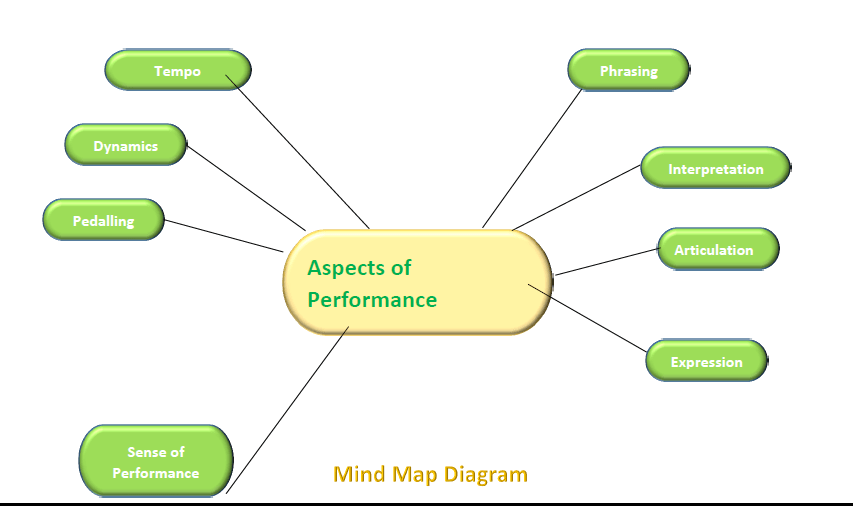
Upon Reflection of the Module (Soledad)
As Darragh has previously explained, participation in this module has become a very positive and interesting experience as a performer.
Generally, most of the pieces that we play as pianists belong to composers who have passed away (including those compositions not very correctly called “contemporary”, works by composers such as Schönberg, Webern, Crumb, Ligeti, Messiaen and a long etcetera).
On the other hand, on other occasions, even if the composer is alive, you rarely have the opportunity to work directly with him or her, and even less do you have the possibility of working side by side from the beginning of the composition.
Indeed, currently the relationships between composers and performers are tightening, all contributing to the creation of the work.
Furthermore, these relationships go beyond national borders. As Darragh indicated, our different backgrounds as well as our current situation are not and have not been an impediment, in any case an incentive and a way to enrich our work.
For all these reasons, I am glad that I had the opportunity to have participated in this collaborative creation and I also wish in the future to be able to debut this piece as it deserves, being able to play it in public with my fellow piano performer and with Pàdruig listening to it live.
Module Reflection (Pàdruig)
This module has been an insightful and successful process through which we have all gained and learned something new about our individual and collaborative practices, despite the latter disruptions of Covid-19. As both Darragh and Soledad have commented above, the process which we have undertaken to take a piece from inception to performance is one which today is commonly found to be symbiotic – and through such a process, the compositional and the performance concerns are all better understood by all parties.
From a composer’s point of view, it is useful to know that performers will feel ownership over a piece of music, so that they are invested in it to the degree to which it will receive ample time, commitment, and depth of understanding. It is also of vital importance that a piece may be playable, and thus that performer concerns may be discussed and aptly considered. It is within the composer’s direct interest to reach for new sounds and vehicles for expression, but (in most cases), these should be achievable in performance, indeed to the premiere performers, and to all potential future performance relying solely on the timeless article of the score.
I am pleased to have worked on this piece with Soledad and Darragh, and to know that we have together written a piece which has dealt with three different streams of influence and input, as well as three different sets of criteria in production and completion. I very much look forward to hearing this piece one day in performance!
Performance Workshop
Overview of Workshop on 05/03/2020 (Darragh)
Yesterday morning, a useful workshop for the composers and performers was held by Prof. Palmer and Dr. Molloy. Soledad and I performed first. Following this, we were given feedback and were asked to perform parts of the piece again, masterclass style. The other performers played too, and some of their feedback was also applicable to our duet performance.
It was very useful performing on this piano as it will be the piano used in the lunchtime recital-particularly for Soledad, as she has harmonics to execute and each piano has a different feel and sound. The piece has got better in terms of synchronicity and now it is time to progress the piece further. We hadn’t given the pauses enough consideration, particularly in the beginning-this was an aspect commented on during the feedback. Padruig’s score is very clear here-so I need to pay attention to this detail. This freedom in the beginning sets the tone for the piece, it’s very calm and still (the end as well). The D section contrasts with the first section as the piece gains momentum and provides a big contrast to the opening section, with the fff chords and the extremities of the piano being used. There is a lot more room for both parts to explore the dynamics and sound world, and my ornaments need to be more articulated. In terms of logistics, Ryan suggested Soledad and I swap just one note, in order to avoid our hands overlapping. This was bar 50.
Also, in the more busy section, section D, I believe we started off with a good sense of pulse but that dwindled slightly by the end of D. I suggest that Soledad and I work on this, perhaps with a metronome first. Dr O’ Leary gave very helpful advice regarding duets. We need to be one player, not two. This means we need to communicate more in order to be singing from the same hymn sheet so to speak-whether it be through eye contact, a gesture etc. He suggested we decide what to do with the rests beforehand, deciding on a certain amount of beats, or elongating the pause each time we do it etc. Overall, the workshop gave us a very good idea of what to work on next in order to strengthen the concept of the piece. No doubt we will try to incorporate these new elements in our next rehearsal.
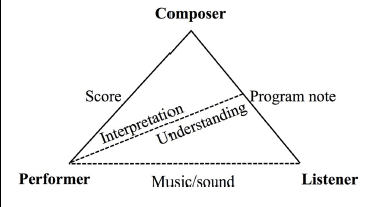
The lunchtime concert is approaching and another aspect that we need to consider concerns the running of the recital itself-the logistics of performing. Introductions (who is the speaker?), acknowledgment of the composer (will we acknowledge the composer by bringing him up on stage at the end?) and timings. Another aspect worth considering in advance is where will Soledad and I sit, and our walk-ons to the stage. Soledad is due to perform as a soloist first, then the duet, then me as a soloist-this means there will be a fair amount of moving around. Finally, the programme notes for the recital must be written. This will include a brief biography on three of us and a short description of the pieces. Programme notes are particularly important for new works. For staple works in the repertory, programme notes do not hold the same practical significance, as the listeners may already have heard the piece before at a previous concert for example. The aim of programme notes is of paramount importance in contemporary classical music in shaping the both the listeners’ and performers’ perceptions and concept of a work. The intriguing relationship between composers, performers, listeners and the score is portrayed below;
As musicians, we spend so much time honing our craft and practising minute details, and sometimes we do not take these logistics and overall presentation into account until the last minute. Sometimes it is hard to do that as we may not be familiar with the set-up, venues and so on. However, in this case (thankfully), we are privy to the set-up of the Riverstown Hall lunchtime recitals. If we are fully prepared for the co-ordination of the performance,it will allow us to concentrate on the most important element-the performance itself!
Video Recordings of Practice (Darragh)
Here are two recordings of my practicing two sections of the piece. I find recording myself a very useful tool in improving. It’s particularly helpful in our case as this is the piano and the recording equipment I will be using for the (Conica microphone)final recording.
Meeting #2
Pàdruig 23/02/20
Long overdue, though not without any correspondence, I met up with Darragh and Soledad individually to look over the score. These were very useful meetings, with several outcomes and points discussed below, which resulted in a number of (minor) modifications to the score (attached below).
Both performers are getting on very well with their parts. I think it would be helpful for them both to meet up as soon as possible so as to get to grips with the challenges that will occur when playing each part in conjunction with the other. This will be particularly apparent when it comes to peddling. I suspect that Darragh will pedal the beginning and the end, and that Soledad will pedal from letter D to bar 60. There is double peddling required in the very last section which I discuss below.
The biggest change that was required was in letter D, where there was frequent overlapping of parts. To avoid this, most occurrences of the ornamental figure in the Primo L.H. (e.g. bar 39) have been moved up an octave. The Secondo part has been moved down an octave in bar 57 to help with spacing as well.
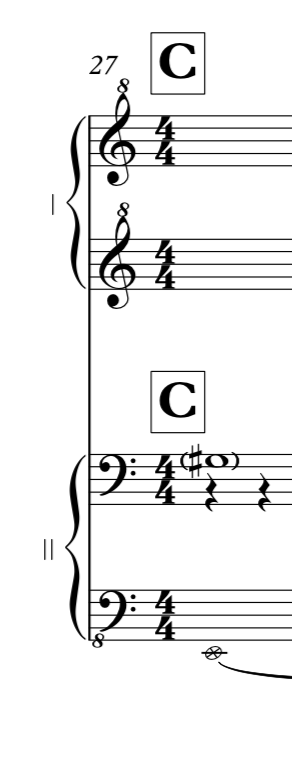
I stress again how important awareness of whether the clefs (as per the example below) are at pitch or if they are an octave up or down, so as to not completely misread certain sections.
When playing through the music, I felt it needed a small amount of adjusting in bars 60 – 62. Rather than both parts playing the start of bars 60 and 61, there is now a rest at the start of bar 60 in the Primo part, so that the big descending run will start after the Secondo’s chord. Likewise, rather than playing together at bar 61, the Secondo part will do the E with the harmonic a bar later.
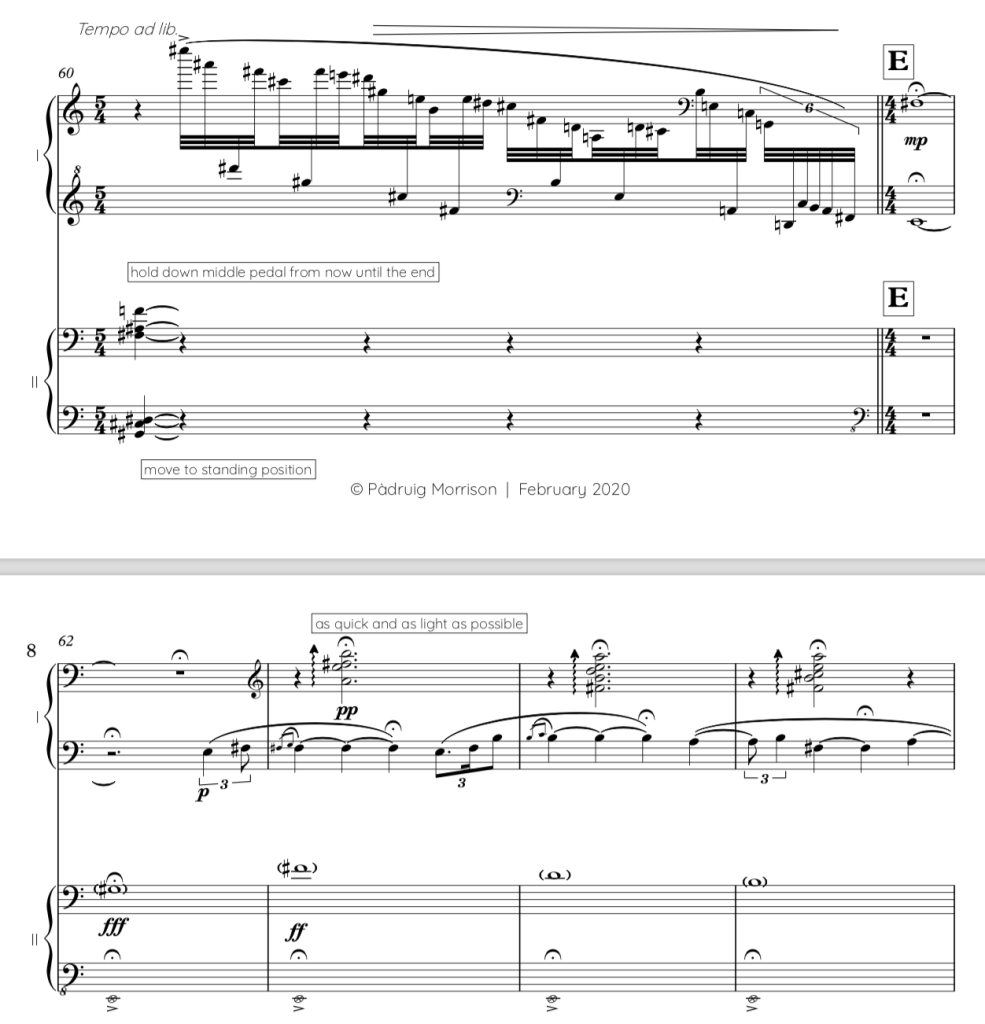
The next alteration that was necessary was from bar 73 to the end. The harmonics from the silently pressed keys are most effective if they are played two octaves lower, with the addition of the sostenuto pedal, and a subtle use of the sustain pedal to cover the change of chord in the Primo part. I have notated it as follows, even though the Primo pianist (Darragh) will probably pedal both.
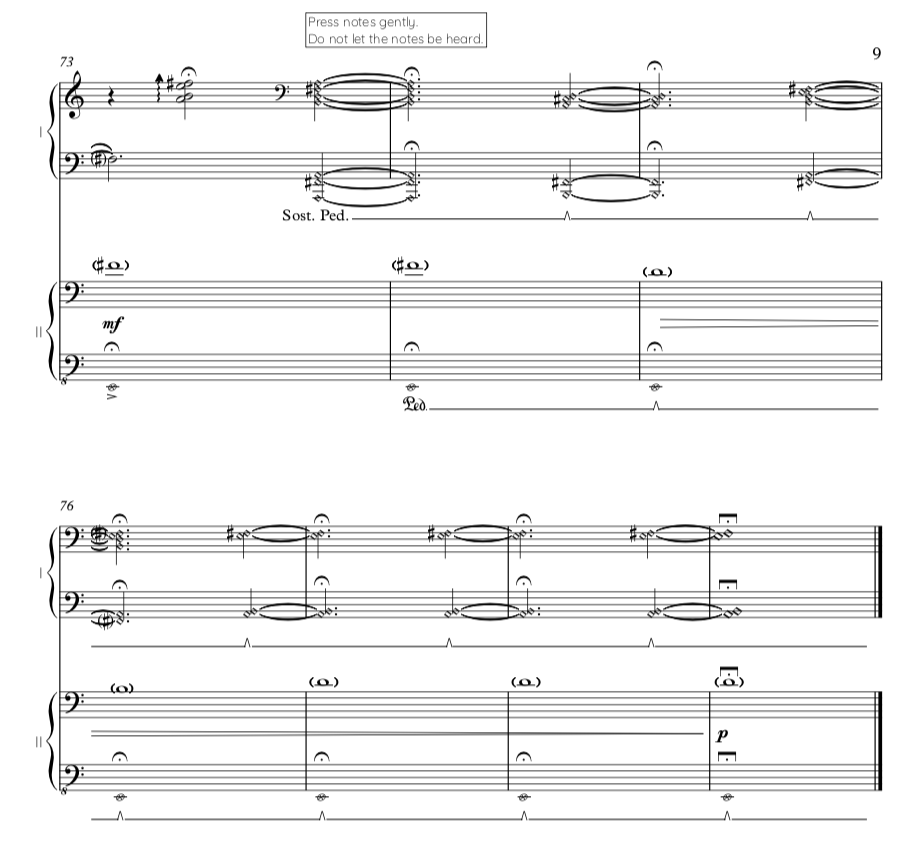
I’m looking forward to hearing the piece with both players. The piece can be done a bit slower that 70bpm is required, and please do practice section D very slowly to begin with.
Below I have a PDF, and a link to download Sib 8, Sib 7 first, or MP3 files should they aid the learning process.
Meeting with Pàdruig and First Rehearsal with Soledad (Darragh 27/02/2020 )
Both Soledad and I met with Pàdruig individually to play through the piece and to see how things work together. There were a few parts where the primo and secondo clashed so Pàdruig promptly fixed this and sent us a revised version. Now the ornamental figures of my primo part are an octave higher, bringing me to the extreme of the piano. Some of Soledad’s parts have been lowered an octave. There are a few spots where our hands slightly overlap but this is manageable. An example of this is the start, where the melody and the chords are in and around the same place.
Pedalling is crucial in this piece. I am pedalling the beginning and the end. Soledad is pedalling section D to bar 60. At the end, the sostenuto pedal must be used as well as the sustain, in order to manage the harmonics. Prior to the first rehearsal with Soledad, I had listened to the Sibelius track of this piece a few times to get more of an idea of the nuts and bolts, however this being a new piece means that it is our responsibility to bring the piece to life. We rehearsed it one section at a time, mostly working on synchronicity. We will rehearse again before the workshop on Wednesday and hopefully the piece will be taking shape by then.
Full piece!
Pàdruig 09/02/20
I have at last completed the piece! Taking on board the comments from our dialogue, I have developed the material, reached a climax, and brought the piece to a close.
A few things to note:
- Throughout, please take special care ensuring that you notice any treble or bass clefs with octave markings as shown here.
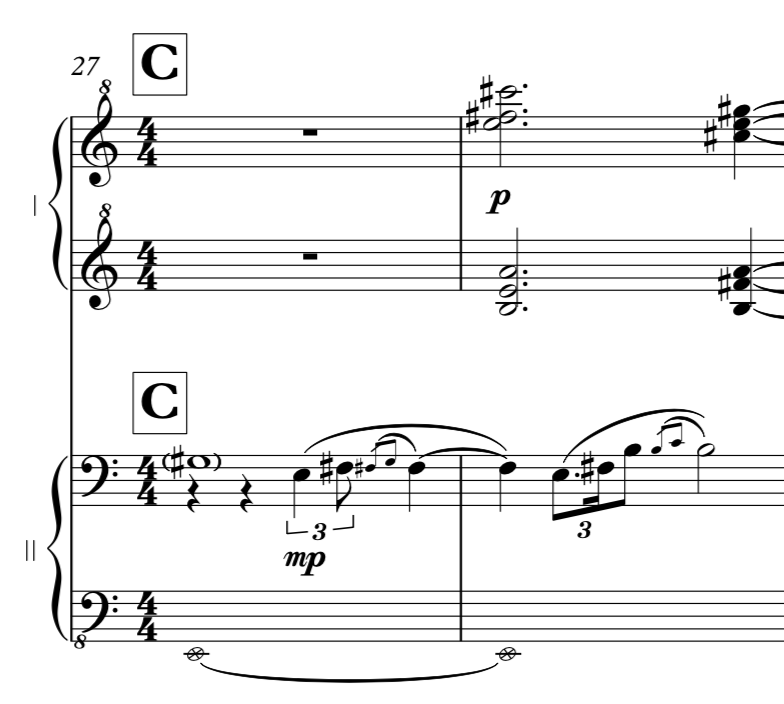
- Like I said before, ornaments are to be played on the beat and as fast as possible.
- The development/climax from D is definitely a good bit harder than the rest. But there’s very little across the crotchet beats, so that should help the practice.
- Let me know if there’s problematic clashes of range. Both parts have a wide range but I hope I’ve ensured they don’t crash into each other!
- Bar 60 in the Primo part, feel free to use both hands for the run. Just a whole tone scale.
- Some double sharps in there (E double sharp FYI). In a couple of places I wrote it enharmonically, but doing so didn’t always make it easier in my mind. I hope all the sharps don’t make for too hard a read.
- From E to the end, the Secondo part could either be played standing, or very far over to the left, as the Primo part comes down into the middle of the keyboard.
- I want to hear how E works, with the middle pedal, and the silent pressing of keys. They should provide a colourful resonance from those low E’s. They are also the same notes as the opening chords, though in reverse order, although that will not be detectable to the ear! Hopefully this sections works okay.
- Let me know if you have any questions!
Pàdruig 17/02/20
I’ve just made one small change compositionally. It is in the Primo part at bar 60. I’ve replaced the whole tone scale with something that is much more appropriate to the material of the whole piece. It is in the score below.
Further Development
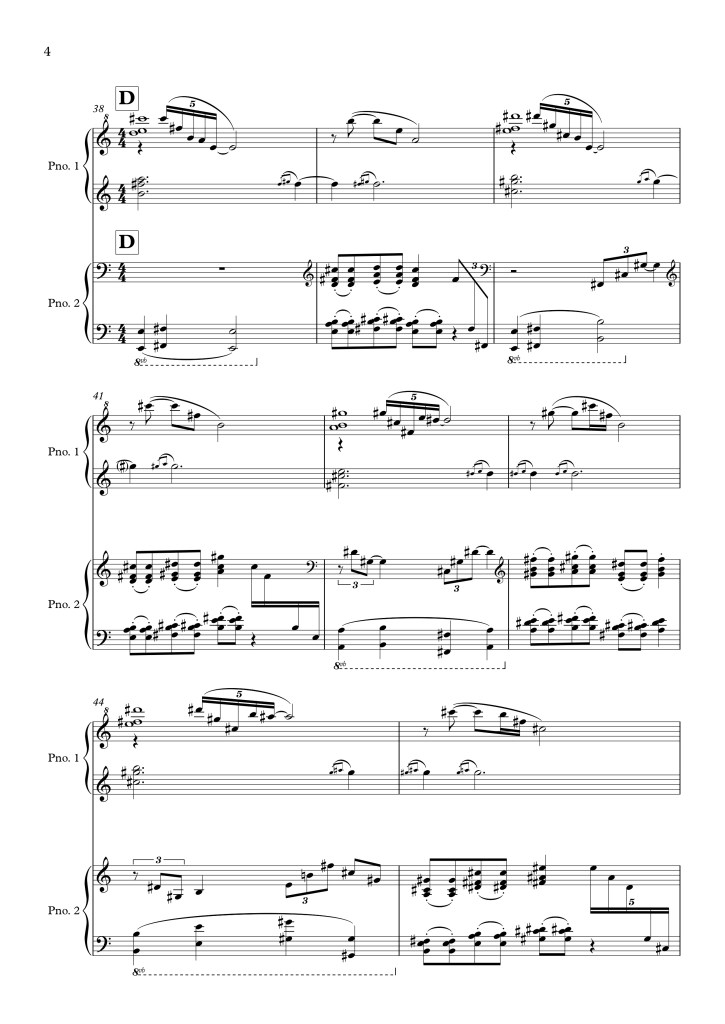
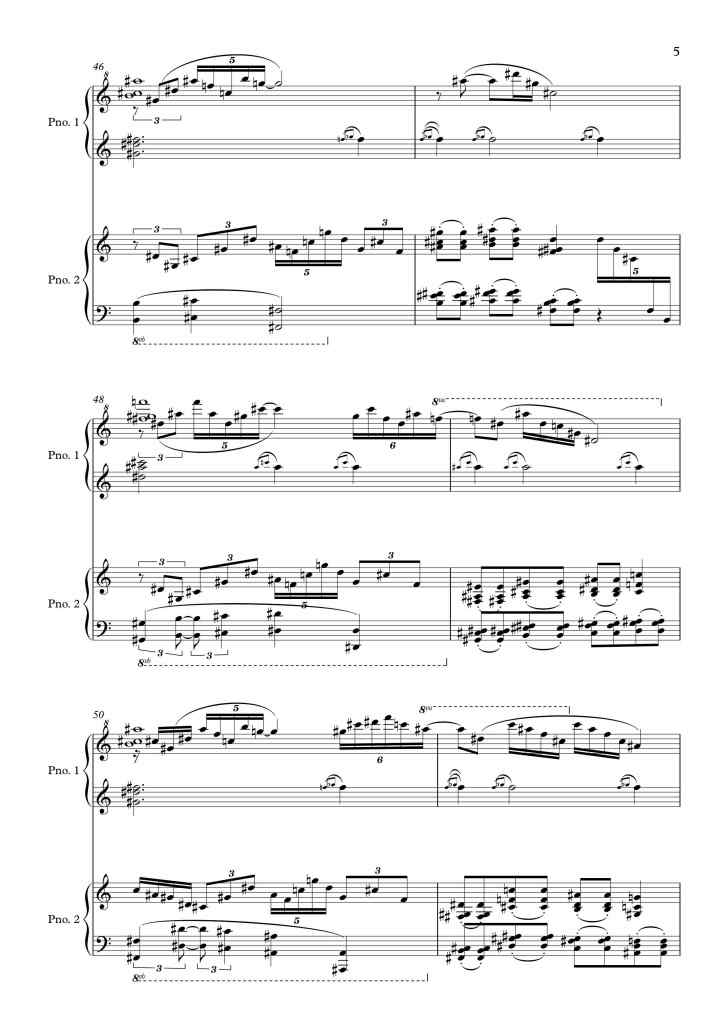
The piece has definitely developed, both in terms of thoroughness of content and in terms of difficulty! Have a look and see what you think!
It might need a wee bit more practice than the rest. Let me know if there is anything in there that is proving overly challenging. Bars 48-52 are the most challenging of the piece, and thereafter I plan for it to recapitulate.
First Draft of ‘Sileán na Carraig’
A week ago I sent over my first draft of the piece, which has the working title ‘Sileán na Carraig’. Based on our group discussion, I wanted to include a theme that was of the style of a traditional slow air. I did a reasonable amount of the composition at the piano, so that I knew it was playable, but also so that I could hear how the harmonies sound – particularly as they increase in distance from the theme’s tonal centre – in relation to the lower part.
Once I have heard a few questions on the music I will be quick to return with a more developed work.
Questions on the First Draft (Darragh 24/01/2020)
On receiving the first draft of the composition, I was intrigued to get started and to find out more about Padruig’s composition methods and his thought process behind the piece. This is an important process as I always endeavour to find out the composer’s intentions before playing a piece.
(1.) The title-Sileán na Carraig: Since this is a traditional based piece, it seems obvious that the title be in Irish! I’m wondering what would the English translation of this be? Something similar to “The Weeping Rock”?
(2.) As we discussed in our first meeting, the basis of this composition draft is a slow air. The elements of slow air combined with contemporary classical music is very evident such as the absence of a strict metre, repeated notes, ornamentation and more. Is this based on any particular slow air? And when you composed this, did you experiment first through playing?
Regarding Technical Demands from a Performer’s Perspective (Darragh 24/01/2020):
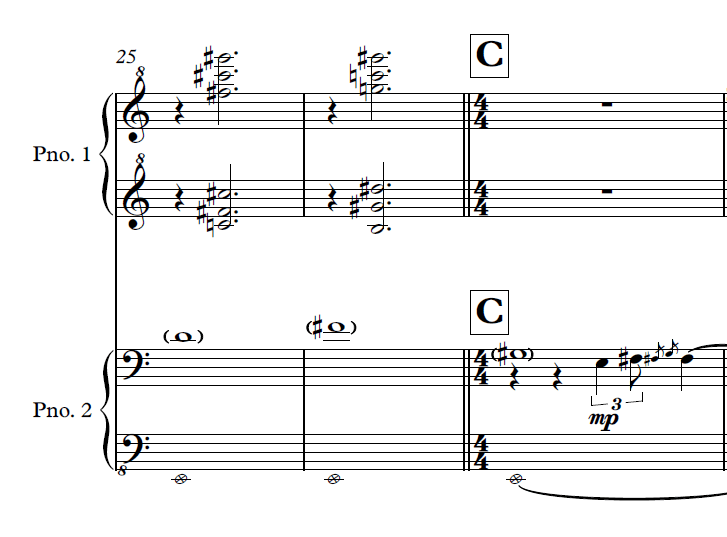
(1) As I’m playing the primo part, I will have to ripple some of the chords as some chords are too large to play at once. Some of the large chords I can manage, however some such as the the chord in bar 26 (left hand), I will have to ripple this;
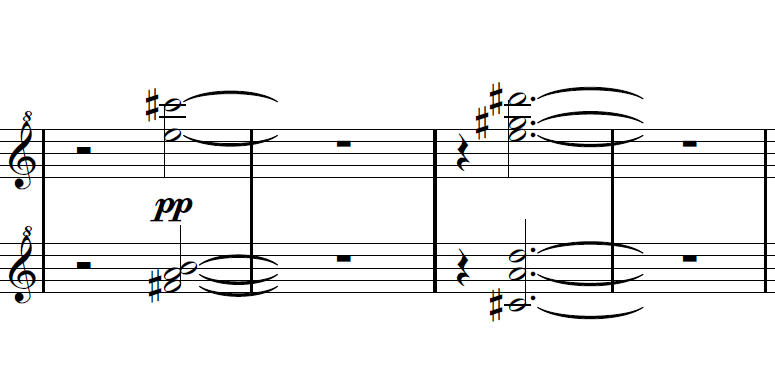
(2.) My last question pertains to bar 20 and 22: I presume the ties mean that the chords are held into the next bar for an indefinite amount of time through the sustain pedal? Here is the relevant section;
Answers 25/01/20 (Pàdruig)
Thank you for your questions!
- Yes the title is along the lines of ‘The Weeping Rock’, or ‘The Rock’s Tears’, as I felt I wanted to pick a subject matter for the title, that felt at home with a context of traditional music. However, the rock also brings to mind matters of size, scale and vastness, an aspect which I hope to consider through the use of harmony. A rock is full of different shapes, contours and colours, which also inspires a multi-modal harmonic approach to the melody, and to the more colourful harmonies.
- The theme (slow air melody) is my own composition. I wrote it with two modes in mind: E dorian, and E lydian. If you split the tune in two, the lower octave is in E dorian, and the upper in E lydian. By moving ever brighter and sharper as the melody goes on, a more colourful harmonic language is facilitated.
I have played it all the piano which was helpful in giving me a feel for how it should turn out. - You are correct to ripple any chords that are too wide. LH bar 26 is too wide for me too, but a swift ripple will work well.
- You are correct that the ties over the barlines to nothing indicate that the chords should resonate until the following bar. However, I think I will modify this – it’s not helpful, and leads to uncertainty about the crotchet rest immediately before the next chord.
Good luck!
Also a question from me – we talked initially about a slow air then becoming something quicker. I’m still worried that doing that would then prohibit the slow section from properly developing. Now that you’ve had a chance to see the material, and the climactic development of the slow air theme is yet to be reached, how do you feel about it’s pacing/development? Do you think we need a faster section too?
Response (Darragh 26/1/2020)
Thank you Pàdruig for answering those questions and for explaining your thought process behind the composition. Regarding your question, I understand your concerns. I think it would be best to develop the slow air, rather than composing a fast section and not give either section the time it deserves to develop. As you mentioned yourself, the climactic development has not yet come to fruition.
For the next while, I will be concentrating on formulating my thoughts on the piece and of course learning it too. I will document my thoughts and learning process in my next post. Once Semester 2 starts, Soledad and I can begin rehearsing, which I am looking forward to. My thesis is related to piano duets and I have not played a piano duet in quite a long time-so this collaboration will be beneficial to me.
Questions on the First Draft (Soledad 26/01/2020)
First, I would like to thank Pàdruig for the composition of this beginning of the work, I am looking forward to play it. Then, I would like to thank Darragh for referring to the title of the composition, since I do not know Irish, it is interesting to know an approximate translation when imagining the piece as a work of programmatic inspiration.
1. Within the interesting explanation you make about the use of the modality, I would like to know how you make the choice of chords, if you choose them purely because of their sonority or if there is an internal process.
2. I also agree on the question you ask about maintaining the slow tempo of the piece, the development must still be sustained to reach the climax, although I would like to suggest something, instead of changing to a faster tempo, could you develop more the piano primo figuration?
Regarding Technical Demands from a Performer’s Perspective (Soledad 26/01/2020):
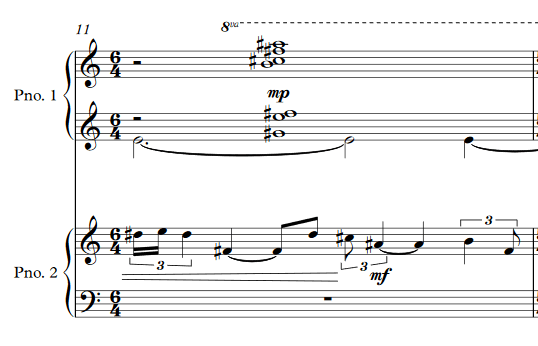
1. Should the mordents that appear in the theme be played quickly? (compared to the written figuration of measure 11 of the piano secondo)
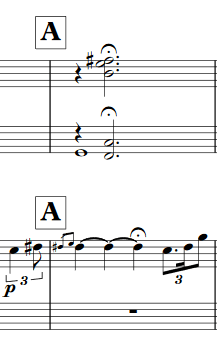
2. When the resonating harmonics appear, you clearly indicate the pitch you want to hear. I understand that it depends on where you stop the string, it will produce a harmonic or another.
3- In section C, should the tonal pedal be used to maintain the bourdon and be able to play the theme clearly or do you want everything to be maintained with the same pedal?
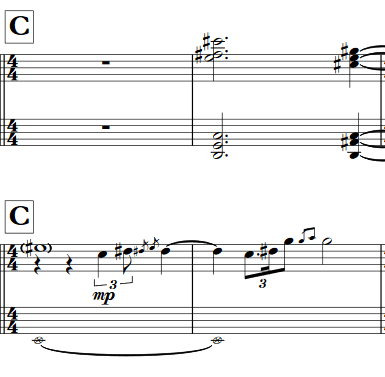
Answers 30/01/2020 (Pàdruig)
Thank you for your thoughtful questions.
1. The process of coming up with the chords involves listening to their sonorities, but also a process of thinking about harmonic colour. The piece begins in the sound world of E dorian, and so initial chord fit with in that mode. As the melody gradually brighten, with the adding of sharps, towards the E lydian mode, so too do the chords brighten. I have then taken this further so that it doesn’t stop at D# or A# but continues pushing upwards and sharper. Hence the E#s (Fs), B#s (Cs), Fdouble#s (Gs) etc.
2. Thank you for the suggestion. I will develop the primo part next and add more movement.
3. Ornaments. The ornaments should be played as fast as possible, and on the beat (not slightly before). This is the traditional style of ornament/gracenote. The main weight is on the first gracenote, then the second gracenote and the main note fall afterwards.
The ornaments should be much fast than the semi-quavers in bar 11.
4. String harmonics. Yes – you are correct. Experiment with it. It will just be a case of moving your finger towards you along the string to get what I have written. Some chalk or postit note might be useful in performance for getting the right place quickly.
5. At C, perhaps the pedalling needs to follow the primo part’s chords, but with the secondo keys held down, it should still resonate. This is something that will be easier to discuss when we are all together at a piano.
Thank you for your questions so far. Which is your preferred sections so far? I will work on the parts now and develop the material of the primo part in particular.
Response (Soledad 01/02/2020)
Thank you very much Pàdruig for the clarity in your answers. Now I know how to play the ornaments that appear on the piano secondo. In relation to the string harmonics, I asked the question because it is curious that some contemporary compositions that I have played with this extended technique indicated the place in which to stop the string. It really seems more accurate to mr what you have done, since you indicate the sound result you want. In any case, the use of some chalk or postit will definitely be helpful.
C is so far my favorite section, I really like how all the materials you have used have converged; the chords of the piano primo, the string harmonics and the main theme.
Finally, the suggestion I made about adding more movement to the piano primo is also related to the title. Earlier you explained that the title is along the lines of ‘The Weeping Rock’, or ‘The Rock’s Tears’, you also added, ‘A rock is full of different shapes, contours and colors’, which is very good translated, from my point of view, to the musical aspect. Perhaps the ‘liquid’ part of the title (weeping, tears) could inspire other shapes and movements.
Meeting #1
All three of us met on October 24th. We had an excellent meeting discussing lots of ideas. As a composer, with regular tendencies towards particular styles, I did not push my ideas at all. However, when discussing a sort of style we might go for, both Darragh and Soledad seemed keen for a traditionally based composition.
We shared ideas about the sounds and contemporary effects on the piano that could work effectively in the piece. Darragh suggested a slow air to begin at least – with potential to have a faster section afterwards, but this will be determined by the length of the piece.
I discussed ideas about the potential for stopped strings, the sympathetic reverberation of low strings, and the huge harmonic scope from having four hands across the keyboard. This was met with positive feedback.
I said I would send some scored ideas by early December. This will be done over the blog.
Reflection of Meeting Number one: (Darragh)
Welcome to our collaborative composition blog! This is a space in which we can document our journey in creating a composition that will be performed as part of the lunchtime recitals in Maynooth University. Throughout the year we can share our thoughts and opinions on our project, as well as recordings, composition drafts and other material that will help bring the piece to its fruition.
Our composition team consists of a composer and two pianists, and we will be playing a Piano for Four Hands composition. We had our initial meeting recently where we brainstormed and got to know each other as musicians. We discussed some of the contemporary pieces we’ve played and certain aspects/techniques that we could utilise in the performance. The role of the composer and performer has differed greatly in the last few decades, with the performer gaining much more freedom to contribute to performance practices of the twenty-first century. The idea of the composer acting as an alone agent, working in isolation has now transformed, no doubt due to advancements in technology, globalisation and more. As Galenson states, ‘artistic innovations are not made by isolated geniuses but are usually based on the lessons of teachers and the collaboration of colleagues.’ (Margaret S. Barret, ed., Collaborative Creative Thought and Practice in Music (Taylor & Francis, 2014),p.3).
Of course, there are benefits to this new way of composing; as well as challenges. There are certain demands and responsibilities on performers; nowadays performers must have knowledge of their instrument’s techniques and various styles, elements that may lie outside of the classical idioms in which they have been taught. In the words of performer and researcher Barrie Webb, performers are no longer ‘second class musicians,’ whose job it is to purely play the score handed to them. (Barrie Webb, ‘Partner in Creation.’ Contemporary Music Review, 26.2(2007), p.255). As a performer, I have never collaborated on a composition before, but now I get the opportunity to do so. Through this, I can gain more understanding into the contemporary role of the composer and performer.
From our discussions, I think we’ve decided on drawing inspiration from both classical and traditional idioms for this composition, which I think will be really intriguing. This combination of idioms written for the genre of a piano duet is definitely a rarity and possesses much room for exploration. The piano duet is a niche genre that has recently garnered more attention-and the genre naturally lends itself to collaboration. Ironically though, it is often stated that a piano duo must sound like one player. In Margaret S. Barret’s Collaborative Creative Thought and Practice in Music, there is a chapter written by Liam Viney and Anna Grinberg about their collaborative journey as a married piano duo. This is of particular relevance to our project (excluding the marriage of course!). On a side note, there is a chapter in this book that Soledad may be interested in, as I know her research interests include Russian piano music; ‘Rimsky-Korsakov and Musorgsky: A Posthumous Collaboration?’ by Simon Perry.
Here are some pieces that we mentioned;
Reflection of Meeting Number one: (Soledad)
As my colleagues have explained previously, the initial meeting served to get to know each other better as musicians. Pàdruig was interested in knowing our performative experience with the most contemporary music and between the three we were shaping what will be the final composition.
While Darragh suggested slow air, I feel more comfortable in a faster tempi so, it was suggested a piece in several movements or with several tempi, such as the `Variations´ op. 27 by Anton Webern.
https://www.youtube.com/watch?v=5hZXpDGQ-0M
In addition to the previous work, I commented another very interesting work that I had also played in which the pianist can work with the amplified piano, `Makrokosmos. Twelve Fantasy-Pieces after the Zodiac´ by George Crumb.
https://www.youtube.com/watch?v=3YTix06IwT4
At that time, as he said at the beginning, Pádruig suggested the possibility of working with stopped strings and the reverberation of the lower strings. Therefore we conclude that I would play the piano secondo part while Darragh would play the piano primo part.
In Spain, where I have been trained, the main influence in contemporary music, both in performance and composition, comes from the German world. For that, I found interesting, as well as Darragh, the suggestion that Pádruig made about a traditionally based composition.
 MU625 Pàdruig - Soledad - Darragh